NFL · LIONS–PACKERS · OPINION & ANALYSIS
Dan Campbell Made the Right Decision
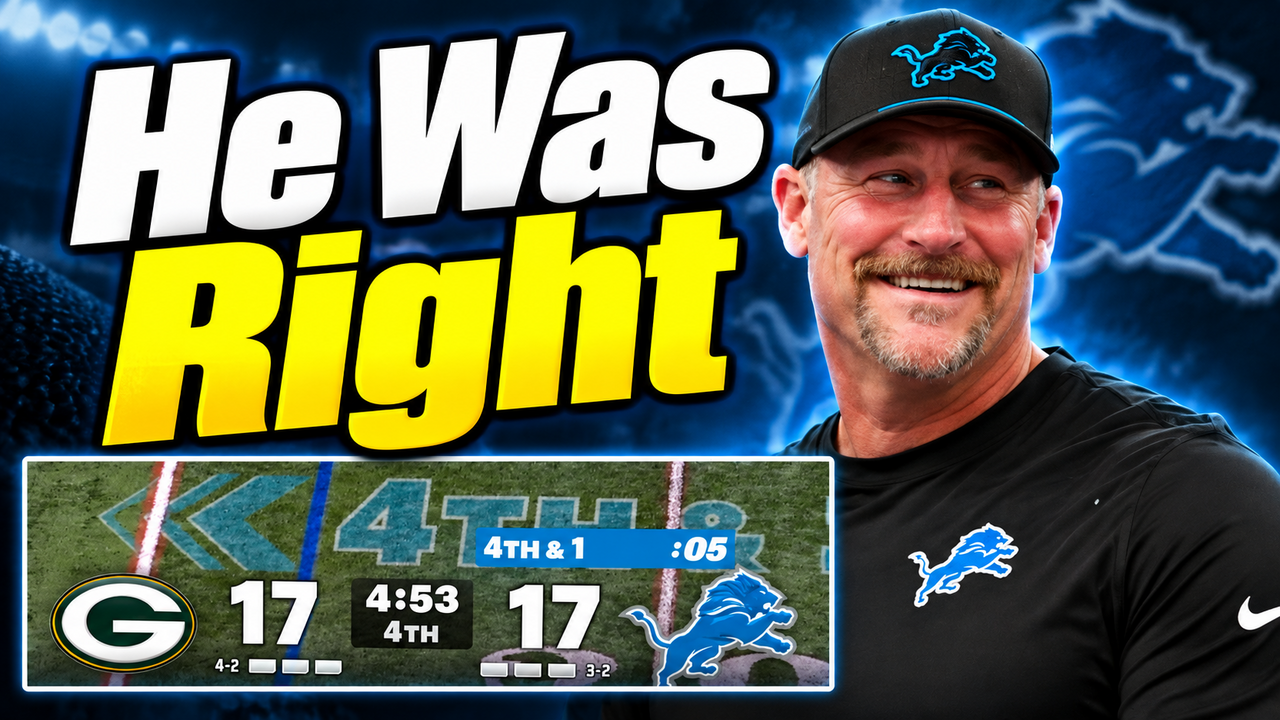
Dan Campbell made the right decision going for it on fourth-and-one against Green Bay. That is our view even though the play failed. The case starts with possession and the clock, not with the fact that Detroit eventually won 20–17.
With the score tied and fewer than five minutes left, Campbell trusted his offense to get one yard. Converting would have kept the ball in Jared Goff’s hands and given Detroit a chance to control the finish. The downside was obvious: a failed attempt would put the Packers in scoring position immediately.
The exact fourth-down sequence
The official NFL gamebook places the fourth-down snap at 4:53 remaining in the fourth quarter. The 4:50 timestamp marks Green Bay’s next possession. Here are the two plays at the center of the decision:
| Clock | Situation | Play and result |
|---|---|---|
| 5:36, Q4 | Third-and-one, Detroit 24 | Goff completed a short pass right to Jahmyr Gibbs for no gain. Dani Dennis-Sutton made the tackle. |
| 4:53, Q4 | Fourth-and-one, Detroit 24 | Gibbs ran up the middle and lost two yards. Keisean Nixon made the tackle. |
Green Bay took over at Detroit’s 22 with 4:50 left. The gamebook describes the run as up the middle; it does not establish the full blocking design or the play’s internal name. Official NFL gamebook, pages 14–15.
The Packers’ preceding drive matters
Green Bay had just used 12 plays, 61 yards and 6:34 to tie the game. That possession started at its own 14 with 13:44 left and ended with Trey Smack’s 43-yard field goal at 7:10.
Christian Watson and Josh Jacobs catches, along with a 10-yard Jacobs run, helped move the ball. A Detroit personal foul and a Green Bay holding penalty also shaped the possession. The Packers had demonstrated that they could put together a long drive and consume a substantial part of the remaining clock. Packers.com game updates; official gamebook.
Our analysis: keep a chance to control the finish
The strongest argument for going is simple: Detroit needed one yard to keep control of the ball. Punting would have improved the field-position situation, but it also would have allowed Green Bay to attempt another clock-consuming drive.
Failing was dangerous. Green Bay received a short field in a tie game. But a shorter scoring possession could still have left Detroit time to answer. That possibility is part of the decision, rather than a claim that failure was harmless.
There was no guaranteed final possession under either choice. Green Bay could have converted first downs after taking over, and Detroit could have forced a stop after punting. The question is which trade-off was worth taking before the ball was snapped. We favor trusting the offense to gain a yard, while recognizing the immediate scoring opportunity it handed Green Bay when the run failed.
Campbell’s explanation, reported by Jeremy Reisman at Pride of Detroit, was that he expected the conversion and believed the Lions could get the ball back if they failed. That is a clearer basis for evaluating the call than simply working backward from the final score. Reisman’s October 25 report.
Written reactions: support and criticism
For the decision: Mike Tomlin defended the possession-and-time rationale, emphasizing the possibility of preserving a late opportunity for Goff to respond. Josh Helmer covered that argument for Lions Wire in a report carried by Yahoo on October 26. Read Helmer’s report.
Model support: Reisman’s Pride of Detroit report also cited Seth Walder’s ESPN decision model as favoring going for it on fourth-and-one. A model is one input to the discussion, not a guarantee of conversion or a substitute for the game’s actual circumstances. Read the model discussion.
Against the decision: Candace Pedraza, writing for SideLion Report on October 26, argued that the short-field risk was too great and credited D.J. Wonnum with bailing Campbell out. That is the strongest counterargument: a tied game gave the coach a reason to protect field position rather than hand the opponent an immediate scoring chance. Read Pedraza’s assessment.
These are attributed paraphrases of selected reactions, not a claim of consensus.
What happened afterward
The Packers gained five yards on three plays from Detroit’s 22. Wonnum then blocked Smack’s 35-yard field-goal attempt. Detroit answered with a 10-play, 71-yard drive, and Jake Bates made a 22-yard field goal as time expired. Official gamebook.
Wonnum’s play was enormous. The win does not erase the risk Campbell accepted, and a failed run does not by itself settle whether going was the wrong decision. Our case for Campbell remains the chance to retain possession, manage the finish and give his offense a path to win the game.